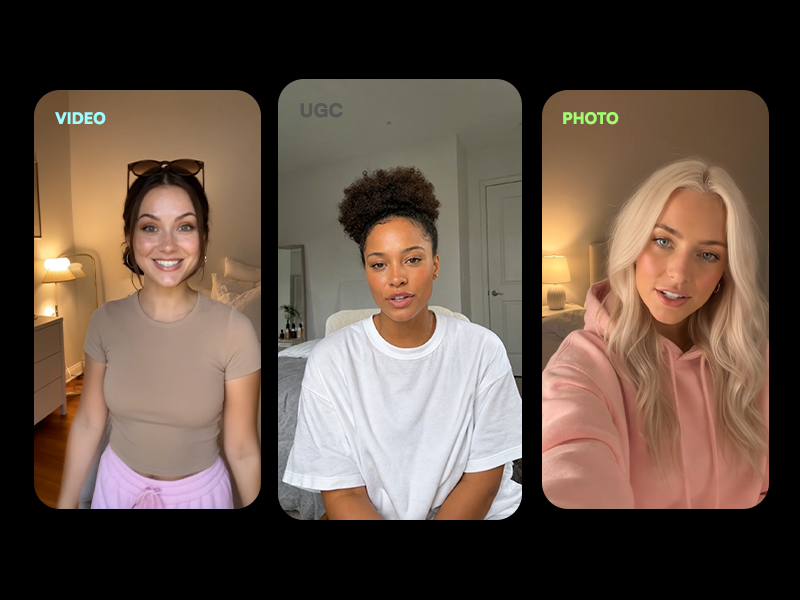
The short version: AI UGC holds its own against human-shot UGC for most direct-response advertising, and beats it handily on one dimension that matters a lot - how much you can test. The longer version comes with some real caveats.
What the market looks like right now
The creator market has been shifting for two years straight. Data from Billo and similar platforms puts the average cost per UGC deliverable at around $198 in 2026 - actually down from prior years, as supply has grown and AI tools have applied price pressure from below.
But $198 is just the average. For a solid 30-second video from a creator who understands direct response, expect to pay $150 to $500 depending on experience and usage rights. Add revisions, coordination time, and the occasional creator who ghosts you, and the real cost per usable ad climbs further.
AI UGC tools have pushed per-video cost down to roughly $2 to $11 depending on platform. Arcads runs about $11 a video at its $110/month starter tier. MakeUGC comes in around $9.80 a video at its $49/month entry point - talking-head clips that, at their best, hold up in a fast-scrolling feed.
Where AI UGC works well
AI UGC is strongest when the job is volume and speed for testing. A media buyer running four creative angles a week can generate all of them in a single afternoon with AI. Doing the same with real creators would take two to three weeks of coordination and cost 10 to 20 times as much.
For direct response specifically, the format that performs best is the talking-head testimonial - someone on camera naming a problem, introducing the product, sharing a result. That structure happens to suit AI avatars well, because it's simple: one person, one background, one script.
Photo ads are the other format where AI has essentially caught up. Tools built on GPT Image produce product shots and lifestyle photography that's genuinely hard to tell from a professional shoot. Our own photo ad output consistently passes the "is this real?" test, which is why we push photo ads as the entry point for brands new to AI creative.
Where AI UGC still struggles
Long-form video and complex scenes remain rough. AI-generated video looks best at 10 to 15 seconds. Past 30 seconds, the odds of something looking off rise fast - a hand moves strangely, lip sync drifts for a beat, an expression doesn't quite match the tone.
Physical product demos are another weak spot. If your ad needs someone holding the product, unboxing it, or demonstrating a feature, most AI tools still can't pull that off convincingly. MakeUGC offers a "product-in-hand" feature on its Pro tier ($119/month), but reviews consistently describe inconsistent results - some shots land, others look obviously fake.
Emotional range is the other limitation. Real creators bring genuine enthusiasm and personality. AI avatars can approximate it, but rarely nail the subtlety. For brands where authenticity and emotional connection carry the value proposition - wellness, mental health, luxury - real creators still have the edge.
The real question isn't "is it good enough"
For most DTC founders, the useful question isn't whether AI UGC can fully replace human creators. It's whether AI UGC can close the gap between "I need 20 ad variations this month" and "I can afford to hire two creators."
The answer to that is clearly yes. Use AI UGC to test hooks, scripts, and angles at volume. Once you find a winning concept, hand it to a real creator to produce the hero version. That gets you the testing speed of AI and the authenticity of a human, applied to your proven winners.
That's roughly how we think about it at Flayr. The weekly drop generates fresh creative every week from competitor intelligence. Most of it is good enough to run profitably as-is - but when one ad overperforms, you know exactly which hook and structure to hand to a real creator for the premium cut.